IMDG refresher training is not optional—it is a core requirement for compliance in maritime logistics. As Amendment 42-24 takes effect in 2025, your team must stay current with updated training expectations. This guide outlines when refresher training is required, who needs it, and how to track it effectively to remain compliant.
What the IMDG Code Says About Refresher Training
According to Chapter 1.3 of the IMDG Code, all shore-based personnel involved in transporting dangerous goods must receive function-specific training. Although the Code does not specify an expiry period, competent authorities typically recommend IMDG refresher training every two years or when the Code changes. Since Amendment 42-24 introduces major updates, 2025 is the ideal time to verify your team’s training status.
Why IMDG Refresher Training Matters More in 2025
In 2025, changes to classification rules, lithium battery handling, and digital documentation come into effect. If your team completed training under Amendment 40-20, they may now be out of date. When refresher training is missed, you risk regulatory breaches, delayed cargo, or endangering safety. As a result, refresher training is no longer optional, it is mission critical.
Who Needs IMDG Refresher Training?
Contrary to common assumptions, refresher training isn’t just for handlers. It is required for any role that influences the transport of dangerous goods:
Freight forwarders and booking staff
Port handlers and stevedores
Warehouse teams managing labelling and packing
Documentation and compliance officers
Dangerous Goods Safety Advisors (DGSA)
Each of these roles contributes to compliance and as such, refresher training ensures they operate within updated regulations.
Planning and Tracking IMDG Refresher Training
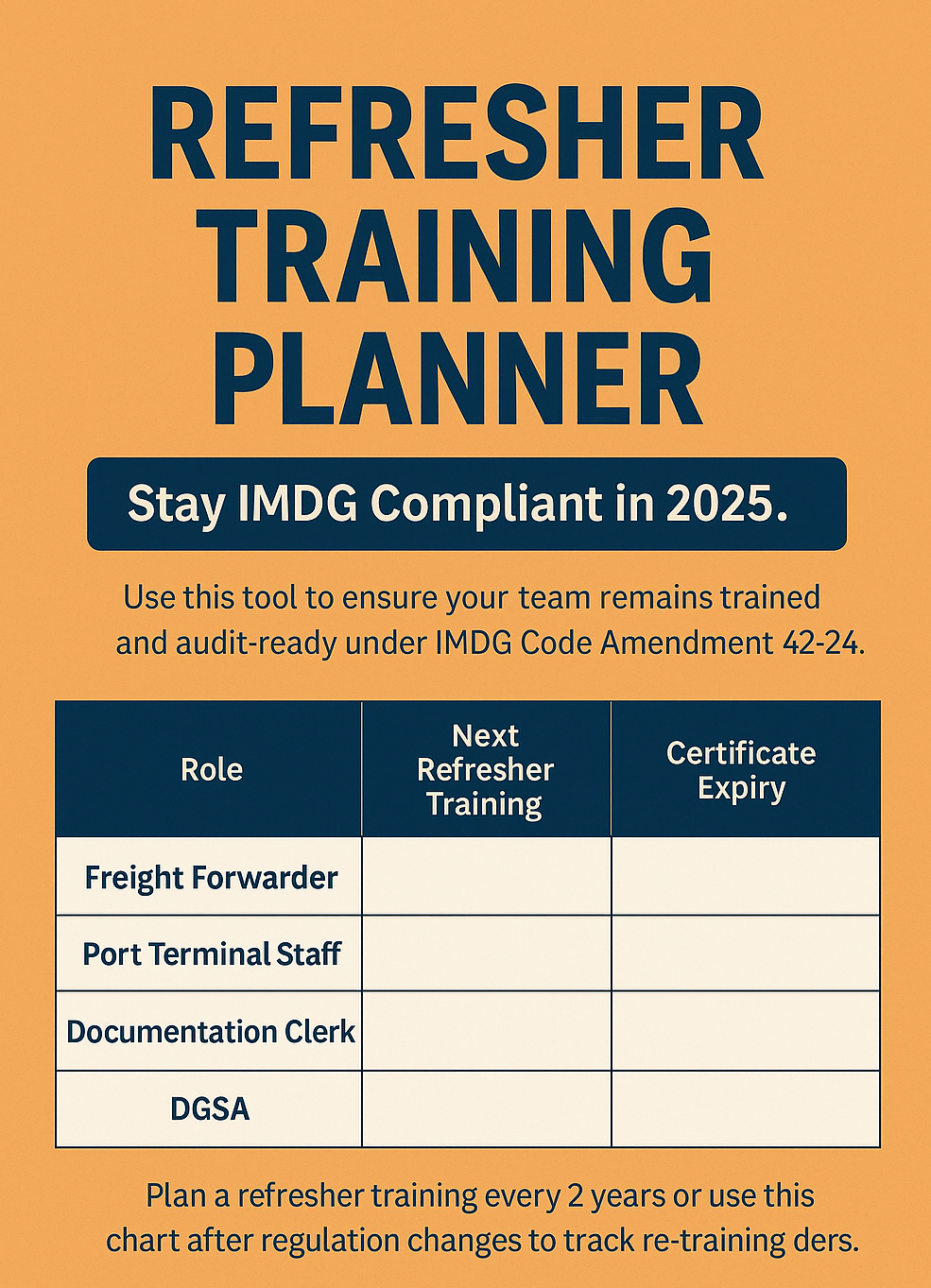
To maintain compliance, organisations must implement a rolling refresher schedule. For example, a simple tracker can record each employee’s last training date, the IMDG Code version used, and their next training due date.
In addition, digital records make audits simpler and reduce manual admin. Rather than using paper certificates, switch to a shared tracker with built-in alerts.
Free Download: Refresher Training Planner
We’ve created a free IMDG refresher training planner to help HR and compliance teams stay audit-ready. It includes:
A 2-year planner with certificate expiry tracking
Pre-filled roles and suggested retraining cycles
A format that works for both print and digital use
📥 Download the free planner and start building your 2025 schedule today.
Refresher training is more than a regulatory requirement. It supports safety, reduces liability, and shows your team that compliance matters. By staying ahead of the 2025 IMDG changes, you reduce risk and build a stronger compliance culture.
Not everyone in the supply chain needs IMDG training — but many more roles require it t
han most realise.W
ith Amendment 42-24 coming into effect in 2025, it’s critical to understand who is legally required to complete training and what those responsibilities entail.
🔍 What the IMDG Code Says About Training
According to Chapter 1.3 of the IMDG Code, all shore-based personnel inv
olved in the transport of dangerous goods by sea must receive function-specific training.
This includes:
Personnel who classify, pack, mark, label or document dangerous goods
Those responsible for loading, unload
ing, or overseeing such activities
Employees who review, sign off, or plan DG shipments
📊 IMDG Training Responsibility Matrix
Role
Training Required?
Key Responsibility
Freight Forwarders & Booking Agents
✅ Yes
Coordinate DG bookings, check classification, arrange transport
Must ensure team compliance and enforce procedures
Administrative Support Staff
🟡 Depends
Only if directly influencing DG documentation or routing
📄 Download the full matrix + FAQ as a cheat sheet → Download PDF
❓ Expert-Level FAQ
Q: Is IMDG training required for office staff who only handle invoices? A: Only if they influence or review dangerous goods information on those documents.
Q: What qualifies as “function-specific” training? A: Training tailored to the employee’s actual job duties under the IMDG Code — not just general awareness.
Q: How often should refresher training be done? A: While not strictly regulated, best practice is every 2 years, or immediately following code updates.
Q: Is online training valid for compliance audits? A: Yes, as long as it’s certified, documented, and includes assessment. SafetyNet’s IMDG e-learning meets these standards.
🔁 Why Training Matters
If required roles are not trained, your company may face:
🚫 Rejected shipments
💸 Fines or revoked approvals
⚠️ Increased risk to worker and environmental safety
🎓 How to Ensure Your Team Is Trained in 2025
To stay compliant:
✅ Enroll staff in certified IMDG e-learning programs
Training isn’t just a regulation — it’s a core pillar of safety. Now more than ever, logistics professionals, safety officers, and compliance teams must know who needs IMDG training and how to deliver it.
The International Maritime Dangerous Goods (IMDG) Code is the cornerstone of global safety in transporting hazardous materials by sea. Updated every two years by the International Maritime Organisation (IMO), the latest revision — Amendment 42-24 — is poised to bring key regulatory changes. This update becomes optional on January 1, 2025, and mandatory on January 1, 2026.
Whether you’re a shipper, freight forwarder, compliance officer, or logistics manager, understanding these changes early can help you avoid costly delays, regulatory penalties, and training gaps.
When Does Amendment 4 2-24 Take Effect?
The IMO adopts IMDG amendments every two years. Amendment 42-24 will be: • Optional from January 1, 2025 • Mandatory from January 1, 2026 This gives organisations one year to transition and update their compliance programs.
Key Changes in IMDG Amendment 42-24
🔹 Dangerous Goods List (DGL) Updates
New UN numbers added for specific materials
Certain substances reclassified under new hazard categories
Packing instructions revised for select classes and combinations
🔹 Lithium Battery Transport
• Revised marking and labelling requirements • Tighter rules for packaging and documentation • Alignment with UN Model Regulations
🔹 Packaging and Labelling Rules
• Enhanced clarity on pictograms and label placement • Updates to limited quantity handling procedures
🔹 Definitions and Editorial Revisions
• Expanded explanations for marine pollutants
• Technical clarifications on classification notes
Who Is Affected by These Changes?
These updates impact a wide range of stakeholders in the DG shipping chain, including: • Shippers and consignors • Freight forwarders and consolidators • Packing and warehouse personnel • DG safety advisors and compliance staff • Maritime operators and vessel planners
How to Stay Compliant
To ensure you’re ready for Amendment 42-24: • Update your training programs early in 2025 • Distribute awareness materials to all affected teams • Review and revise your internal documentation and SOPs • Monitor IMO bulletins and check for national adoption notices • Work with a certified DG training provider to stay ahead
Download the IMDG 2025 Cheat Sheet
Want a one-page summary of all the key changes? Download our free IMDG 2025 Cheat Sheet. It includes the most critical updates in Amendment 42-24, explained clearly for shippers, forwarders, and compliance teams.
Regulatory updates are a constant in the world of dangerous goods transport. Being proactive, well-informed, and properly trained isn’t just good practice — it’s mandatory. Start preparing now so you’re not scrambling in 2026. Need help? Visit IMDG-course.com to explore accredited online training options or book a consultation with our compliance experts.
IMDG training in 2025 isn’t optional — it’s a legal requirement that’s more relevant than ever. With new dangerous goods regulations entering force under Amendment 42-24, global maritime teams must ensure their staff are properly trained and certified. Failing to do so means exposure to delays, penalties, and safety risks. Here’s why training matters — and how to stay ahead with our IMDG e-learning courses.
📘 What Is the IMDG Code and Why It Requires Training
The International Maritime Dangerous Goods (IMDG) Code, created by the International Maritime Organization (IMO), sets the global standard for transpor
ting hazardous goods by sea. The code is mandatory under SOLAS and MARPOL agreements. Without certified IMDG training, your teams could violate international law and endanger cargo, vessels, and crew.
👉 Learn more about the IMDG Code (IMO official site)
📘 New Training Requirements in 2025 (Amendment 42-24)
To remain compliant in 2025, training programs must address:
Lithium battery classification updates
Mandatory refresher training cycles
New packaging & labeling rules
Digital documentation expectations
Expanded responsibility for shore-based staff
These changes will be optional in 2025 and mandatory by 2026.
📘 Who Needs IMDG Training in 2025?
Everyone involved in preparing, packing, handling, or shipping dangerous goods must be trained. This includes:
Freight forwarders
Port and terminal operators
Logistics managers
Dangerous goods safety advisors (DGSAs)
Warehouse and packaging teams
Shipping agents and booking staff
📘 Why IMDG Training in 2025 Is a Smart Investment
Having your team trained reduces:
Risk of non-compliance fines
Delays due to rejected cargo
Human error in documentation or labeling
Reputational damage from unsafe practices
It also prepares your business to scale safely across global trade lanes.
🎓 Our IMDG E-Learning Course: Updated for 2025
Our accredited IMDG e-learning course is:
Self-paced and mobile-friendly
Aligned with Amendment 42-24
Designed for all key maritime roles
Includes certificate upon completion
✅ Final Thoughts
With IMDG training in 2025 more critical than ever, now is the time to act. Don’t wait for enforcement deadlines — be the company that’s always ahead of the curve.
The International Maritime Dangerous Goods (IMDG) Code serves as a critical framework for the safe transport of hazardous materials by sea. Established by the International Maritime Organization (IMO), this code outlines the necessary regulations and guidelines that ensure the safety of crew members, vessels, and the marine environment. It is essential for all stakeholders involved in the shipping of dangerous goods to familiarize themselves with the IMDG Code, as it provides comprehensive information on classification, packaging, labeling, and documentation requirements.
The code is updated periodically to reflect advancements in safety practices and emerging risks, making it imperative for industry professionals to stay informed about the latest revisions. Understanding the IMDG Code is not merely about compliance; it is about fostering a culture of safety within the maritime industry. By adhering to the guidelines set forth in the code, companies can significantly reduce the risk of accidents and incidents during transportation.
This not only protects human life but also safeguards the environment from potential hazards associated with spills or leaks. As global trade continues to expand, the importance of the IMDG Code becomes increasingly evident, highlighting the need for robust safety measures in the transport of dangerous goods. Learn more about IMDG courses at IMDG courses.
Key Takeaways
Understanding the IMDG Code is crucial for safe transport of dangerous goods
Proper identification and classification of dangerous goods is essential for safe handling
Safe handling practices for dangerous goods are necessary to prevent accidents and injuries
Proper training is important for all personnel involved in handling dangerous goods
Packaging and marking requirements must be strictly followed for safe transport of dangerous goods
Identifying and Classifying Dangerous Goods
Accurate Identification and Classification
The first step in ensuring safe transport is accurately identifying and classifying dangerous goods. The IMDG Code categorizes these materials into nine distinct classes based on their inherent properties and associated risks. These classes range from explosives and gases to flammable liquids and toxic substances.
Consequences of Misclassification
Each category has specific criteria that must be met for proper classification, which is crucial for determining appropriate handling and transport methods. Misclassification can lead to severe consequences, including accidents, legal penalties, and environmental damage.
Facilitating Accurate Identification
To facilitate accurate identification, shippers must conduct thorough assessments of the materials they intend to transport. This involves reviewing safety data sheets (SDS), understanding chemical properties, and consulting relevant regulations. Additionally, proper training in recognizing hazardous materials is essential for personnel involved in shipping operations. By ensuring that all team members are equipped with the knowledge to identify and classify dangerous goods correctly, organizations can enhance their safety protocols and minimize risks associated with transportation.
Safe Handling Practices for Dangerous Goods
Safe handling practices are paramount when dealing with dangerous goods, as improper handling can lead to catastrophic outcomes. Organizations must implement strict protocols that govern how these materials are managed throughout their lifecycle—from loading and unloading to storage and transport. This includes using appropriate personal protective equipment (PPE), employing specialized handling techniques, and ensuring that all personnel are trained in emergency response procedures.
By fostering a culture of safety and vigilance, companies can significantly mitigate risks associated with handling hazardous materials. Moreover, regular audits and inspections should be conducted to ensure compliance with established safety practices. These evaluations help identify potential hazards and areas for improvement, allowing organizations to adapt their procedures accordingly.
Additionally, fostering open communication among team members regarding safety concerns can lead to a more proactive approach to risk management. By prioritizing safe handling practices, organizations not only protect their employees but also contribute to a safer maritime environment.
The Importance of Proper Training for Handling Dangerous Goods
Proper training is a cornerstone of effective dangerous goods management. The IMDG Code emphasizes the necessity of training for all personnel involved in the transport of hazardous materials. This training should encompass a wide range of topics, including classification, labeling, packaging requirements, and emergency response procedures.
By equipping employees with comprehensive knowledge about dangerous goods, organizations can enhance their overall safety culture and ensure compliance with regulatory standards. Training should not be a one-time event; it must be an ongoing process that evolves with changes in regulations and industry best practices. Regular refresher courses and updates on new developments in the IMDG Code are essential for maintaining a knowledgeable workforce.
Furthermore, organizations should consider utilizing various training methods—such as hands-on exercises, simulations, and e-learning platforms—to cater to different learning styles and reinforce key concepts effectively. By investing in continuous training, companies can foster a workforce that is well-prepared to handle dangerous goods safely and efficiently.
Packaging and Marking Requirements for Dangerous Goods
Packaging plays a crucial role in ensuring the safe transport of dangerous goods. The IMDG Code outlines specific packaging requirements that must be adhered to based on the type of material being transported. Proper packaging not only protects the contents from damage during transit but also minimizes the risk of leaks or spills that could pose hazards to human health and the environment.
Shippers must select appropriate containers that meet international standards and are designed to withstand various conditions encountered during transportation. In addition to packaging requirements, marking and labeling are essential components of safe transport practices. Each package containing dangerous goods must be clearly marked with appropriate hazard symbols and information that indicate the nature of the contents.
This labeling serves as a vital communication tool for all parties involved in the shipping process, from handlers to emergency responders. By ensuring that packaging and marking requirements are met, organizations can significantly reduce the likelihood of accidents and enhance overall safety during transport.
Storing and Segregating Dangerous Goods
Designing Storage Facilities
These storage facilities should be equipped with appropriate safety features, including spill containment systems and fire suppression equipment, to mitigate potential risks.
Segregation of Hazardous Materials
Segregation is another important aspect of storing dangerous goods. Different classes of hazardous materials may react adversely when stored together, leading to dangerous situations such as fires or explosions. The IMDG Code provides guidelines on how to segregate incompatible materials effectively.
Creating a Safer Environment
By implementing proper storage practices and segregation protocols, organizations can create a safer environment for employees while minimizing risks associated with hazardous materials.
Emergency Response and Contingency Planning for Dangerous Goods
Despite best efforts to ensure safety, emergencies can still occur during the transport of dangerous goods. Therefore, having a robust emergency response plan is essential for mitigating potential impacts in case of an incident. Organizations should develop comprehensive contingency plans that outline procedures for responding to various scenarios involving hazardous materials—such as spills, leaks, or fires.
These plans should include clear roles and responsibilities for personnel, communication protocols, and coordination with local emergency services. Regular drills and training exercises are vital for ensuring that employees are familiar with emergency response procedures. These simulations help reinforce knowledge and build confidence among team members when faced with real-life situations.
Additionally, organizations should continuously review and update their emergency response plans based on lessons learned from past incidents or changes in regulations. By prioritizing emergency preparedness, companies can minimize risks associated with dangerous goods transportation while safeguarding their employees and the environment.
Documentation and Reporting Requirements for Dangerous Goods
Accurate documentation is a fundamental aspect of transporting dangerous goods safely. The IMDG Code mandates specific documentation requirements that must be fulfilled before shipping hazardous materials. This includes preparing a dangerous goods declaration that provides essential information about the contents being transported—such as classification, packaging details, and emergency contact information.
Proper documentation ensures that all parties involved in the shipping process are aware of the risks associated with the materials being handled. In addition to documentation requirements, organizations must also adhere to reporting obligations in case of incidents involving dangerous goods. This includes notifying relevant authorities about spills or accidents promptly and providing detailed reports on the circumstances surrounding the event.
Maintaining accurate records not only helps organizations comply with regulatory standards but also facilitates continuous improvement by identifying areas for enhancement in safety practices.
Compliance with IMDG Regulations: Ensuring Safe Transport of Dangerous Goods
Compliance with IMDG regulations is non-negotiable when it comes to transporting dangerous goods safely. Organizations must stay abreast of changes in regulations and ensure that their practices align with current standards set forth by the IMDG Code. This involves conducting regular audits of internal processes, training programs, and safety protocols to identify any gaps in compliance.
Moreover, fostering a culture of accountability within an organization is crucial for maintaining compliance with IMDG regulations. Employees at all levels should understand their roles in ensuring safe transport practices and feel empowered to report any concerns or violations they observe. By prioritizing compliance as a core value within the organization, companies can enhance their reputation while contributing to safer maritime operations.
The Role of Technology in Safe Handling of Dangerous Goods
Technology plays an increasingly vital role in enhancing safety during the handling of dangerous goods. Innovations such as automated tracking systems, real-time monitoring tools, and advanced data analytics have transformed how organizations manage hazardous materials throughout their lifecycle. These technologies enable companies to monitor conditions during transport—such as temperature fluctuations or exposure to moisture—ensuring that products remain within safe parameters.
Additionally, technology can streamline training processes by providing interactive learning experiences through virtual reality simulations or e-learning platforms. These tools allow employees to engage with realistic scenarios related to dangerous goods handling without exposing them to actual risks. By leveraging technology effectively, organizations can improve safety outcomes while optimizing operational efficiency in managing hazardous materials.
Continuous Improvement: Updating and Maintaining IMDG Training and Knowledge
Continuous improvement is essential for maintaining high standards in handling dangerous goods safely. Organizations must prioritize ongoing training initiatives that keep employees informed about updates to the IMDG Code and emerging best practices within the industry. Regularly scheduled training sessions should incorporate new developments in regulations while reinforcing foundational knowledge related to hazardous materials management.
Furthermore, organizations should encourage a culture of knowledge sharing among employees by facilitating discussions on lessons learned from incidents or near-misses involving dangerous goods transportation. This collaborative approach fosters an environment where individuals feel comfortable sharing insights that could lead to improved safety practices across the organization. By committing to continuous improvement efforts—through training updates, knowledge sharing initiatives, and proactive engagement—companies can enhance their overall safety performance while ensuring compliance with IMDG regulations.
In conclusion, navigating the complexities associated with transporting dangerous goods requires a comprehensive understanding of regulations like the IMDG Code along with a commitment to safety at every level within an organization. By prioritizing proper training, safe handling practices, effective documentation processes, compliance measures, technological advancements, and continuous improvement efforts—companies can significantly reduce risks while promoting safer maritime operations for all stakeholders involved in this critical aspect of global trade.
If you are interested in learning more about the IMDG Essentials: Safe Handling of Dangerous Goods course, you may also want to check out the article on the IMDG Course website titled “Top Reasons to Enroll in an IMDG Training Course.” This article provides valuable insights into the benefits of taking an IMDG training course and how it can help you enhance your knowledge and skills in handling dangerous goods safely. To read more about this topic, visit here.