
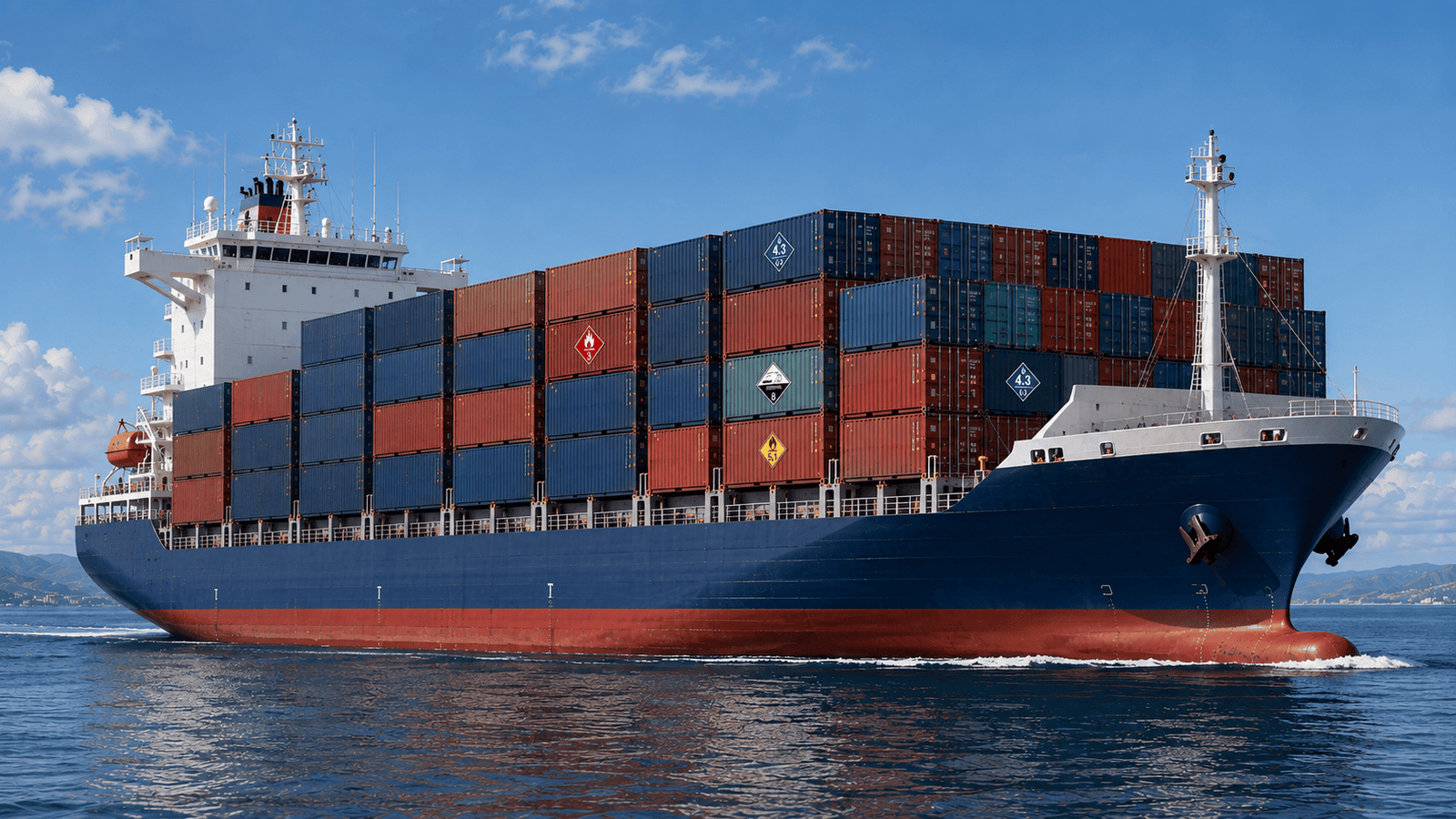
The safe transport of dangerous goods by sea is not only a matter of using the correct packaging, marks, labels and documentation. An equally important part of maritime safety is ensuring that substances capable of reacting dangerously with one another are not stowed too close together. This principle is known as segregation under the International Maritime Dangerous Goods (IMDG) Code.
Segregation is necessary because an otherwise manageable incident can become much more serious when incompatible substances are involved. A leaking package, damaged container, fire or spill may bring materials into contact that react chemically, intensify a fire, generate toxic gases or create other dangerous conditions. The purpose of segregation is therefore to introduce sufficient distance, structural separation, or both, between incompatible cargoes. Official maritime guidance describes segregation as the separation of incompatible products by distance, steel bulkheads or decks, or a combination of these measures.
Understanding the segregation table
The IMDG Code contains a general segregation table in which dangerous goods classes are compared with each other. Depending on the combination, the table may indicate a number from 1 to 4, an “X”, or another applicable provision. The numbers represent increasingly stringent levels of segregation.
The four principal terms are “away from”, “separated from”, “separated by a complete compartment or hold from”, and “separated longitudinally by an intervening complete compartment or hold from”.
The table should never be used in isolation. The Dangerous Goods List must also be checked because individual UN entries may contain specific segregation provisions that override or supplement the general class-based requirement. Subsidiary hazards and segregation groups can also influence the final decision.
This distinction is especially important for container transport. The simple descriptions of the four segregation levels explain the principle, but the exact arrangement of cargo transport units on board depends on factors such as whether the CTUs are open or closed, whether they are carried on deck or under deck, and whether separation is longitudinal or athwartships. Amendment 42-24 contains detailed tables for these situations.
Level 1 — “Away from”
“Away from” is the lowest formal level of segregation. It does not mean that the two dangerous goods are compatible. Instead, it means that they need sufficient separation to reduce the possibility that leakage, fire, damage or another incident involving one cargo could directly affect the other.
For conventional stowage, this is commonly represented by a minimum horizontal separation of 3 metres. This provides a useful training rule for understanding the basic concept: the cargoes may be relatively close, but they must not be positioned as if they were completely compatible.
For containerised cargo, however, the arrangement is more nuanced. It is incorrect to assume that every “away from” requirement simply means “three metres between containers”. For example, under the current IMDG requirements for ro-ro ships, certain combinations of closed CTUs subject to “away from” may have no additional separation restriction, while open-versus-open CTUs may require at least 3 metres.
This illustrates an important principle in IMDG training: the segregation term tells you the required level of protection, while the ship-specific segregation table tells you how that protection must be achieved in practice.
Packing incompatible dangerous goods together in the same CTU should therefore not be presented as generally acceptable. Any such arrangement must be specifically permitted by the applicable provisions of the Code and must satisfy the relevant packing and segregation requirements.
Level 2 — “Separated from”
The second level, “separated from”, represents a substantially stronger requirement. The aim is to ensure that incompatible dangerous goods are not positioned in a way that allows a fire, spill or chemical reaction involving one cargo to readily spread to the other.
For conventional cargo carried on deck, the familiar rule is a horizontal separation of at least 6 metres. Under-deck conventional stowage generally requires the goods to be in different compartments or holds. Depending on the construction of the ship, suitable vertical separation may be acceptable where the intervening deck provides the required resistance to fire and liquid.
For containerised dangerous goods, goods subject to this segregation requirement should not simply be loaded together inside one ordinary container. Their placement aboard the ship must instead comply with the applicable CTU segregation table.
This is where statements such as “one container length apart” can become misleading if presented as a universal rule. The actual requirement varies according to the type of CTUs and their position. For example, the Amendment 42-24 table for ro-ro ships specifies different minimum distances for fore-and-aft and athwartships separation, and distinguishes closed from open CTUs. For “separated from”, distances can range from 3 metres to 12 metres or may alternatively be achieved by an appropriate bulkhead, depending on the configuration.
A common class-based example from segregation training is Class 3 flammable liquids in relation to Class 5.1 oxidizing substances, for which the general segregation table indicates a “separated from” requirement. The reason is easy to understand: an oxidizer can intensify combustion and therefore significantly worsen a fire involving flammable liquids.
Start your IMDG Packer course today!
Level 3 — “Separated by a complete compartment or hold from”
Level 3 introduces a much stronger physical separation. The term itself explains the principle: a complete compartment or hold must provide separation between the incompatible cargoes.
For conventional cargo, this may mean that the dangerous goods are placed in different holds with an appropriate complete structural separation between them. Where vertical separation is used, the intervening deck must satisfy the applicable fire- and liquid-resistance requirements.
On deck, the corresponding separation becomes considerably greater. For conventional stowage, level 3 is generally associated with at least 12 metres horizontal separation.
Container ships require even more careful interpretation. It is not enough to say that two containers should simply have “several spaces between them”. The Code contains detailed CTU segregation arrangements that depend on the orientation, type and position of the containers.
The current ro-ro segregation table illustrates how much stricter level 3 becomes. Depending on the combination, “separated by a complete compartment or hold from” may require 12, 24 or 36 metres of separation, a deck in combination with distance, or two decks or two bulkheads. Certain configurations are prohibited altogether.
That is why a training illustration for level 3 is best shown as containers in separate holds with a complete intervening compartment, or as containers separated by an appropriate structural deck or bulkhead, rather than by showing loose drums standing in a ship’s hold.
Segregation is more than a distance rule
One of the most important lessons for ship operators, packers, freight forwarders and dangerous goods personnel is that IMDG segregation cannot be reduced to a simple sequence of “3 metres, 6 metres and 12 metres”. Those distances are useful for explaining the underlying hierarchy, particularly for conventional stowage, but containerised maritime transport has more detailed rules.
The exact arrangement depends on the substance, its primary and subsidiary hazards, the applicable segregation group, the type of CTU, whether it is open or closed, where it is positioned on the ship, and the construction of the vessel. The IMDG Code therefore requires users to combine the general segregation table with the Dangerous Goods List and the relevant Part 7 provisions.
It is also important not to confuse a marine pollutant mark with a dangerous goods class. “Marine pollutant” is an environmental designation, not a separate hazard class for the purpose of the general segregation table. Segregation must always be determined from the actual IMDG class or classes and any specific segregation provisions assigned to the substance.
Why correct segregation matters
Segregation is ultimately about preventing one incident from becoming several incidents at the same time. A damaged package may leak. A container may be involved in a fire. Seawater may enter a cargo space. A reacting substance may produce heat or flammable gas. Correct segregation gives the crew and the ship’s structural protection systems time and space to prevent escalation.
For that reason, segregation planning should take place before loading begins. The correct UN number, Proper Shipping Name, class, subsidiary hazard and segregation provisions must be known before a container is allocated a position on board.
The IMDG Code exists precisely because the behaviour of dangerous goods at sea cannot be managed by intuition alone. The safest approach is therefore always the same: identify the goods correctly, check the applicable segregation entry, consult the Dangerous Goods List and apply the detailed Part 7 requirements for the actual ship and cargo configuration. The IMO itself emphasises that the Code provides detailed requirements for individual substances and places particular importance on the segregation of incompatible substances.
Start your IMDG Packer course Now!
