
How to Complete an IMDG Transport Document Correctly
Transporting dangerous goods by sea requires more than selecting suitable packaging and applying the correct labels. The people responsible for accepting, handling, stowing and transporting the cargo must also receive accurate information about the dangerous goods being shipped. The dangerous goods transport document is one of the principal ways in which this information moves through the maritime transport chain.
Completing an IMDG transport document correctly therefore requires more than entering a UN number and product name into a form. The description must follow the sequence prescribed by the IMDG Code, while additional information may be required depending on the substance, packaging, environmental hazards and circumstances of transport.
For consignors and freight forwarders, understanding these requirements is essential. Documentation errors can lead to rejected bookings, delays at terminals and discrepancies between the physical shipment and the information available to the carrier.
Start with the correct dangerous goods classification
A transport document can only be correct if the dangerous goods have first been classified correctly.
Before preparing the documentation, the consignor needs to establish the applicable UN number, Proper Shipping Name, hazard class or division and, where assigned, packing group. Other characteristics may also be relevant, such as subsidiary hazards, marine pollutant status or the need for a technical name.
This information should come from a reliable classification process.
The commercial name of a product is not necessarily its Proper Shipping Name. A product sold under a brand name may contain a substance or mixture classified under an entirely different transport description.
The safety data sheet can provide useful information, particularly Section 14, but personnel preparing dangerous goods shipments should understand that the consignor remains responsible for providing correct transport information. Data should therefore be verified when necessary rather than copied automatically from a document of uncertain quality or age.
Once the classification has been established, the basic dangerous goods description can be prepared.
The basic IMDG dangerous goods description
One of the most important requirements is the sequence in which the basic dangerous goods information is presented.
Under the IMDG Code, the basic description generally consists of the UN number preceded by the letters “UN”, the Proper Shipping Name, the primary hazard class or division and the packing group where one is assigned.
Consider a straightforward example:
UN 1263, PAINT, 3, II
This compact description contains several important pieces of information. UN 1263 identifies the entry in the Dangerous Goods List, PAINT is the Proper Shipping Name, Class 3 identifies the primary hazard and Packing Group II indicates the applicable degree of danger within the packing group system.
The sequence matters.
Personnel preparing transport documents should not rearrange these elements simply because another format appears more convenient. Consistent presentation allows parties throughout the international transport chain to recognise the dangerous goods information quickly.
Additional information can then be added where required by the IMDG Code.
Proper Shipping Names and technical names
Selecting the Proper Shipping Name is a frequent source of documentation errors.
The name used for transport must correspond with the applicable entry in the Dangerous Goods List. Commercial names should not replace the Proper Shipping Name.
Some generic and “not otherwise specified” entries require additional technical information. In these cases, the Proper Shipping Name may need to be supplemented with the recognised chemical or technical name of the substance responsible for the hazard.
The technical name is normally shown in parentheses in association with the Proper Shipping Name.
This is particularly relevant for mixtures and products that cannot be assigned to a more specific named entry.
Personnel should therefore be cautious when using descriptions containing wording such as “N.O.S.” A generic entry may be correct, but it can trigger additional documentation requirements that would not apply to a specifically named substance.
Include subsidiary hazards and packing groups correctly
Dangerous goods can present more than one hazard.
Where a substance or article has a subsidiary hazard, this information may need to appear in the dangerous goods description in accordance with the IMDG requirements. The primary class alone may not provide sufficient information about the hazards of the consignment.
Packing groups also require careful attention.
Packing Group I generally represents a high degree of danger, Packing Group II a medium degree of danger and Packing Group III a lower degree of danger within classes where packing groups are assigned.
Not every dangerous good has a packing group. Employees should therefore never add one simply because their documentation software contains a packing group field.
The information entered must correspond with the applicable classification and Dangerous Goods List entry.
Marine pollutants require additional attention
Environmental hazards are particularly important in maritime transport.
Where dangerous goods meet the IMDG criteria for a marine pollutant, the transport document must reflect the applicable requirements. The words MARINE POLLUTANT may need to be included in association with the dangerous goods description.
This information is important because the marine environment is a central consideration within the IMDG Code and MARPOL framework.
Shippers should therefore determine marine pollutant status during classification rather than treating it as an administrative question when the document is prepared.
This also needs to correspond with the physical package. Where the marine pollutant mark is required on packages or cargo transport units, the documentation and physical shipment should tell the same regulatory story.
Quantity and type of packages
The transport document must provide information about the dangerous goods being offered for transport, including the number and kind of packages and the quantity of dangerous goods.
Descriptions should be sufficiently clear to identify the packages involved.
For example, a consignment may consist of drums, boxes, intermediate bulk containers or another authorised packaging type. The information should correspond with the actual shipment.
Quantity information must also be presented in the required manner.
This is an area where mistakes can occur when information is transferred automatically from commercial invoices or warehouse systems. Commercial quantities and dangerous goods transport quantities are not always expressed in exactly the same way.
The dangerous goods document should therefore be checked independently against the physical consignment and applicable IMDG requirements.
Additional information for particular dangerous goods
Not every IMDG transport document contains exactly the same fields.
Certain dangerous goods require additional information because of their specific characteristics or transport conditions. Depending on the shipment, this can include technical names, flashpoint information, control and emergency temperatures, waste information, salvage packaging information or other statements prescribed by the Code.
Limited quantities and other special situations can also require particular consideration.
This is why using an old dangerous goods declaration as a template can be risky. Two products may both belong to Class 3 but have very different documentation requirements.
The person preparing the document must understand the specific entry and provisions applicable to the consignment rather than treating all dangerous goods within one class as identical.
The consignor must certify the consignment
A critical element of the IMDG dangerous goods transport document is the consignor’s certification.
The consignor certifies that the consignment is accurately described and that the dangerous goods are classified, packaged, marked and labelled or placarded, as appropriate, and are in proper condition for transport according to the applicable regulations.
This certification demonstrates why dangerous goods documentation is not simply an administrative function.
The person signing or otherwise authenticating the declaration is connecting the information on the document to the compliance status of the physical shipment.
Companies should therefore establish clear internal authorisation procedures. Employees should know who may prepare dangerous goods documentation and who is authorised to certify it.
The requirement should never be reduced to “someone needs to sign the form.”
Container/Vehicle Packing Certificate
When dangerous goods are packed into a container or vehicle, another important certification may be required: the Container/Vehicle Packing Certificate.
This certificate confirms that the cargo transport unit has been packed in accordance with the applicable requirements. It relates to matters such as the suitability of the container, inspection of packages, segregation, loading and securing of the cargo.
The Dangerous Goods Declaration and Container/Vehicle Packing Certificate serve different purposes, although they are frequently incorporated into the same document.
The Multimodal Dangerous Goods Form facilitates this combined approach.
Where one document contains both declarations, companies should still understand that different persons or organisations may be responsible for the underlying activities. The consignor’s dangerous goods declaration does not automatically mean that the same person physically supervised the packing of the container.
Check the document against the physical shipment
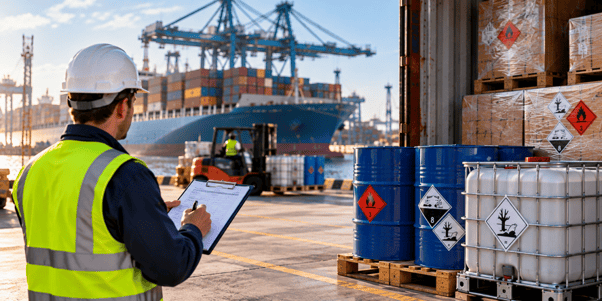
One of the best ways to reduce documentation errors is to perform a final comparison between the transport document and the actual shipment.
The UN numbers and Proper Shipping Names should correspond with the goods being shipped. Package counts and packaging types should match. Marks and labels on the packages should be consistent with the classification shown on the documentation.
Container placards and marks should also correspond with the dangerous goods loaded inside where applicable.
This final verification can identify simple but potentially serious errors, such as documentation prepared for ten drums when only eight are shipped, an outdated packing group or a label that does not match the declared hazard class.
Digital systems can help automate parts of this process, but they do not eliminate the need for competent personnel.
Train personnel responsible for IMDG documentation
Preparing dangerous goods documentation is a function that requires appropriate knowledge of the IMDG Code.
The E-learning IMDG Code Consignor Course (English) from IMDG-course.com is designed for personnel responsible for preparing and offering dangerous goods for maritime transport. The training covers the consignor’s responsibilities and includes important subjects such as classification, packaging, marking, labelling and dangerous goods documentation.
For companies handling regular maritime dangerous goods shipments, training the personnel who prepare transport documents can help reduce errors before cargo reaches the freight forwarder, terminal or shipping line.
Make sure your dangerous goods documentation is prepared by personnel who understand what they are declaring.
Visit IMDG-course.com and view the IMDG Code Consignor Course for function-specific online IMDG training.
Accurate documentation is part of safe transport
A correctly completed IMDG transport document connects the physical dangerous goods shipment with the information required by everyone involved in its maritime transport.
The process begins with correct classification and continues through the selection of the UN number, Proper Shipping Name, hazard class, packing group and any required additional information. Package and quantity information must correspond with the actual consignment, and the consignor must understand the significance of the certification being provided.
The most effective approach is therefore not to view the transport document as paperwork completed immediately before departure.
Documentation should be the final representation of a correctly prepared dangerous goods shipment.
When classification, packaging, marking, labelling and documentation all correspond, the transport document becomes what it is intended to be: a reliable source of dangerous goods information throughout the maritime transport chain.
