
What is an IMDG Dangerous Goods Declaration?
Every day, thousands of containers carrying dangerous goods move through ports and across oceans. The packages may be correctly manufactured, tested, marked and labelled, but the people responsible for accepting, handling, stowing and transporting them cannot see what is actually inside. They depend on accurate information supplied by the consignor.
This is where the IMDG Dangerous Goods Declaration becomes essential.
The term is widely used throughout the shipping industry, although the International Maritime Dangerous Goods (IMDG) Code primarily refers to the dangerous goods transport document and the certification made by the consignor. Together, these provide the carrier with the information needed to identify the dangerous goods and confirm that the consignment has been prepared in accordance with the applicable requirements.
A Dangerous Goods Declaration is therefore much more than another shipping document. It is one of the principal ways in which regulatory and safety information is transferred from the consignor to the maritime transport chain.
The legal basis is Chapter 5.4
The documentation requirements for dangerous goods are primarily contained in Chapter 5.4 of the IMDG Code.
The basic principle is straightforward. When dangerous goods are offered for transport, the consignor must provide the carrier with the information applicable to those goods, including any additional information and documentation required by the Code.
The purpose of this information is not administrative convenience. It communicates the fundamental information concerning the hazards of the goods.
The shipping line, terminal and vessel operator need to know exactly what is being transported. That information can influence acceptance, handling, stowage, segregation and emergency response decisions.
Importantly, the IMDG Code does not require the dangerous goods transport document to follow one compulsory layout. It may be in any form, provided it contains all the information required by the Code.
This explains why Dangerous Goods Declarations from different shipping companies or logistics providers can look different while still serving the same regulatory purpose.
The dangerous goods description
At the heart of the declaration is the dangerous goods description.
The IMDG Code specifies how the essential elements of this description must be presented. For most dangerous goods, this includes the UN number, Proper Shipping Name, class or division, subsidiary hazard where applicable and packing group where assigned.
A simple example could be:
UN 1263 PAINT, 3, II
This short description contains a considerable amount of regulatory information.
“UN 1263” identifies the dangerous goods entry. “PAINT” is the Proper Shipping Name. “3” identifies the primary hazard as Class 3 flammable liquid, while “II” indicates Packing Group II.
Depending on the substance and circumstances, considerably more information may be required.
The description may need to address matters such as marine pollutant status, technical names for certain N.O.S. or generic entries, flashpoint where required, wastes, elevated temperature substances, empty uncleaned packagings or other special circumstances.
The correct description therefore cannot simply be guessed from the commercial name on the product.
Commercial product names are not enough
A chemical may be sold under a highly recognisable trade name, but that does not make the trade name its regulatory transport identity.
The IMDG Code works with UN numbers and Proper Shipping Names so that dangerous goods can be identified consistently throughout international transport.
Imagine a product marketed as “SuperClean Industrial Solvent 5000”. That name may be useful to the customer and manufacturer, but it tells a vessel operator very little about its transport hazard.
The dangerous goods declaration must communicate the regulatory information established through classification.
This is one reason correct classification is so important. Documentation is downstream from classification. If the classification is wrong, the declaration can be perfectly typed and still communicate incorrect information.
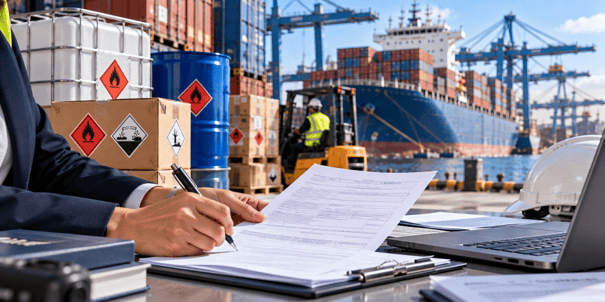
Packages and quantities must correspond with reality
The declaration also needs to describe the physical consignment.
Information concerning the number and type of packages and the quantity of dangerous goods must be provided as required by Chapter 5.4. The document should therefore correspond with the cargo actually being offered for transport.
This sounds obvious, but documentation errors frequently arise because previous declarations are copied and reused.
A company may ship the same product every week and create a new document from an earlier shipment. If the number of drums changes from 20 to 18, or the package type changes, that information must also change on the declaration.
The same principle applies when several dangerous goods are included in one shipment.
The declaration is not a generic description of what the company normally ships. It describes a specific consignment being offered for transport.
What does the consignor actually declare?
The certification is what makes the Dangerous Goods Declaration particularly significant.
The consignor certifies that the consignment has been properly described and that the dangerous goods have been classified, packaged, marked and labelled or placarded as required and are in proper condition for transport according to the applicable international and national regulations.
This means that the declaration extends far beyond the accuracy of a UN number.
By making the certification, the consignor is confirming that several essential parts of the dangerous goods preparation process have been addressed correctly.
The declaration must be signed and dated by the consignor. Where electronic methods are used, the IMDG Code also provides for appropriate electronic authentication arrangements.
The signature should therefore never be regarded as an administrative formality.
The person signing should understand what is being certified.
Is a specific Dangerous Goods Declaration form mandatory?
This is an area where confusion frequently arises.
The answer is no: the IMDG Code does not require one universally compulsory Dangerous Goods Declaration layout.
Chapter 5.4 permits a dangerous goods transport document to be in any form, provided it contains the information required by the Code. This allows shipping lines, freight forwarders and logistics companies to use their own systems and documentation formats.
The IMDG Code does, however, include the Multimodal Dangerous Goods Form as a model.
This provides a convenient internationally recognised format and can combine dangerous goods transport information with other relevant certification. Its widespread use is therefore understandable, particularly in multimodal transport chains.
The important compliance question is not whether a company’s document looks exactly like the IMO model.
The important question is whether all required information has been correctly provided.
Dangerous Goods Declaration versus Container Packing Certificate
Another distinction that needs to be understood concerns the Container/Vehicle Packing Certificate.
These two certifications address related but different responsibilities.
The dangerous goods declaration concerns the dangerous goods consignment and confirms matters including classification, packaging, marking, labelling or placarding and proper condition for transport.
The Container/Vehicle Packing Certificate concerns the way dangerous goods have been packed or loaded into a cargo transport unit.
For example, a chemical manufacturer may prepare 40 correctly packaged and labelled drums and issue the dangerous goods documentation. A separate logistics company may subsequently load those drums into a freight container.
The consignor and the person responsible for container packing are therefore not necessarily the same party.
The Multimodal Dangerous Goods Form is useful because it can accommodate both functions within a single document, but the underlying responsibilities remain distinct.
Electronic declarations are permitted
Modern shipping increasingly operates without paper moving physically alongside every consignment.
Chapter 5.4 recognises the use of electronic data processing (EDP) and electronic data interchange (EDI) as alternatives to traditional paper documentation.
This is particularly relevant as dangerous goods information becomes integrated into carrier booking systems, terminal platforms and digital logistics networks.
However, digitalisation does not reduce the requirement for accuracy.
If anything, an error entered electronically can travel through the supply chain faster than an error written on paper. Incorrect information can be transferred automatically between systems and reproduced in bookings, manifests and operational planning.
The consignor remains responsible for supplying correct information regardless of the technology used to transmit it.
Where information is provided through EDP or EDI, the consignor must also be able to produce the information without delay as a paper document in the sequence required by Chapter 5.4.
Why errors in declarations matter
A Dangerous Goods Declaration can directly influence operational decisions aboard a vessel.
Dangerous goods may have specific stowage requirements. Certain substances must be segregated from incompatible cargo. Some products present particular fire, toxic, corrosive or environmental hazards.
If the cargo is declared incorrectly, those controls can be undermined.
An incorrect class may affect stowage decisions. An omitted subsidiary hazard can hide an important additional risk. Failure to identify a marine pollutant can result in incorrect environmental hazard communication. An incorrect Proper Shipping Name or packing group can create uncertainty throughout the logistics chain.
This is why dangerous goods documentation should not be delegated to personnel who merely know how to complete fields in a software system.
They need to understand what the information means.
The declaration and the freight forwarder
Freight forwarders are frequently involved in the documentation process.
They may receive dangerous goods information from a customer, prepare shipping documentation, submit information to a carrier or arrange a dangerous goods booking.
This does not mean a freight forwarder should casually change the classification supplied by the consignor.
Where information appears incomplete or inconsistent, clarification should be obtained from the responsible party. The forwarder’s role is not to invent missing dangerous goods information simply to make a booking system accept the shipment.
Personnel preparing or checking documentation therefore need sufficient IMDG knowledge to recognise the regulatory information they are handling and understand when further verification is necessary.
Training for personnel preparing declarations
Chapter 1.3 of the IMDG Code requires shore-based personnel involved in dangerous goods transport to receive training commensurate with their responsibilities.
Documentation is one of the functions for which appropriate IMDG knowledge is particularly important.
Employees preparing Dangerous Goods Declarations need to understand the relationship between classification, UN numbers, Proper Shipping Names, classes, subsidiary hazards, packing groups, package information and additional documentation requirements.
For consignors, freight forwarders and personnel who prepare or check dangerous goods documentation, the E-learning IMDG Code Consignor Course (English) available through IMDG-course.com provides function-specific training covering documentation and other requirements associated with preparing dangerous goods shipments for sea transport.
General IMDG Awareness training may be appropriate for employees who only need a general understanding of the system, but personnel directly responsible for dangerous goods declarations need knowledge appropriate to that function.
More than a piece of paper
A Dangerous Goods Declaration is sometimes viewed as the final administrative step before a shipment is booked.
In reality, it is the output of everything that should already have happened correctly.
The substance has been classified. The appropriate packaging provisions have been determined. The goods have been packed, marked and labelled. The required transport information has been established. The consignor then communicates that information to the carrier and certifies that the consignment is in proper condition for transport.
That is why the declaration matters.
A container may be physically closed and sealed, preventing the people further down the transport chain from inspecting its individual packages. The information supplied by the consignor therefore becomes their window into the cargo.
A good Dangerous Goods Declaration does more than satisfy Chapter 5.4. It ensures that the people responsible for moving dangerous goods across the sea know what they are dealing with – and can make the right decisions to transport them safely.
