
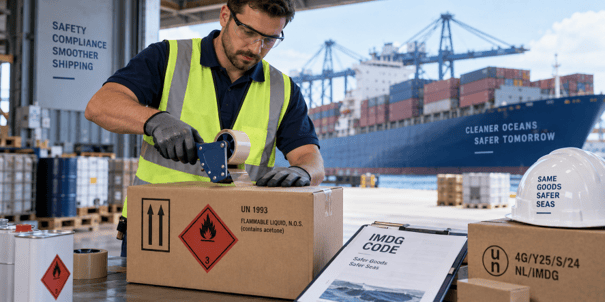
Dangerous goods do not suddenly become a maritime safety issue when a container is lifted onto a vessel. Long before the ship leaves port, important decisions have already been made about how the dangerous goods are packed, marked, labelled and prepared for transport. A person packing dangerous goods therefore occupies an important position in the maritime dangerous goods transport chain.
This raises a practical question for manufacturers, warehouses, logistics companies and packing facilities: what IMDG training does a packer actually need?
The answer can be found in Chapter 1.3 of the International Maritime Dangerous Goods (IMDG) Code. The basic principle is that shore-based personnel involved in the transport of dangerous goods by sea must receive training that is appropriate to their responsibilities. This means that training should not simply be selected because somebody is broadly “involved with dangerous goods”. It should correspond with the functions that the employee actually performs.
For a person who physically packs dangerous goods, general IMDG awareness alone will therefore often not be sufficient.
IMDG training is based on the employee’s function
Chapter 1.3 of the IMDG Code identifies numerous shore-based activities for which personnel require appropriate training. These include classifying dangerous goods, packing dangerous goods, marking and labelling packages, loading or unloading Cargo Transport Units (CTUs), preparing dangerous goods documentation and offering dangerous goods for transport.
The distinction is important. An administrative employee who occasionally processes information relating to dangerous goods has very different responsibilities from a warehouse employee who selects a packaging, closes a combination package or prepares packages containing dangerous goods for shipment.
Under the IMDG Code, employees must be trained before assuming their dangerous goods responsibilities. Where the necessary training has not yet been provided, they may only perform those functions under the direct supervision of a trained person. Training also has to be periodically supplemented by refresher training so that changes in regulations and working practices are taken into account.
For employers, this makes a function-based training matrix particularly useful. Instead of asking, “Does this employee have an IMDG certificate?”, the better question is: “Has this employee been trained for the IMDG functions he or she actually performs?”
What should an IMDG packer know?
The indicative training guidance in Chapter 1.3 provides a useful picture of the subjects relevant to personnel who pack dangerous goods. A packer should understand the dangerous goods classes and, importantly, the packaging requirements applicable to the products being handled.
This includes understanding the different types of packaging that can be encountered in dangerous goods transport and recognising the significance of UN specification markings on approved packaging. A UN marking is not simply a quality logo. It provides information about the design type and performance level of the packaging and forms part of the system used to determine whether a packaging is suitable for particular dangerous goods.
A packer should also understand that finding a UN-approved box, drum or IBC is not in itself sufficient. The applicable entry in the Dangerous Goods List must be considered together with the relevant packing instruction and any special packing provisions. The permitted packaging depends on factors such as the UN number, classification, packing group and physical characteristics of the substance or article.
Correct closure is equally important. Dangerous goods packages have to withstand the conditions normally encountered during transport, including handling, vibration and changes in temperature, humidity and pressure. A technically suitable packaging that is incorrectly assembled or closed can still create a serious transport risk.
That is why practical packing knowledge is an essential part of the packer’s function-specific training.
Limited and excepted quantities are part of the job
Packers may also encounter dangerous goods shipped under the Limited Quantity or Excepted Quantity provisions. These regimes provide certain exemptions from the full IMDG requirements, but they do not mean that the goods cease to be dangerous goods.
A packer therefore needs to recognise when these provisions may be used and understand the associated packaging and marking requirements. Simply placing a Limited Quantity mark on a package does not make the shipment compliant.
For Limited Quantities, for example, the maximum permitted quantity per inner packaging must be checked against the relevant Dangerous Goods List entry. The complete package must then comply with the applicable requirements of the Code. Excepted Quantities have their own quantity limits, packaging provisions, testing requirements and marking system.
This is one reason why training focused specifically on the packer’s responsibilities is more useful than a very general introduction to maritime dangerous goods.
Marking and labelling cannot be separated from packing
In many companies, the person packing the goods also applies the UN number, hazard labels and other required package markings. Where this is part of the employee’s job, the training must also cover those responsibilities.
The packer should be able to recognise the principal hazard classes, primary and subsidiary risk labels and relevant marks such as the marine pollutant mark. The employee should also understand the difference between package marks and labels and the placards and marks that may subsequently be required on a freight container or other CTU.
This is particularly important because a correctly packed product can still be rejected during transport if its package is incorrectly marked or labelled. More importantly, incorrect hazard communication can prevent terminal personnel, vessel crews and emergency responders from immediately recognising the hazards involved.
Function-specific training therefore needs to reflect the real workflow. If an employee packs, marks and labels dangerous goods, all three functions should be incorporated into the employee’s training programme.
Safety training is also required
The IMDG training provisions are not limited to learning how to use tables and packing instructions. Safety training is another important element.
Training should be appropriate to the risk of exposure and the functions performed. For a packer, this can include accident-prevention procedures, safe use of handling equipment, available emergency response information and the hazards associated with the different dangerous goods classes.
Personnel should know how exposure can be prevented and when personal protective equipment is required. They should also understand the immediate actions to take following an unintended release of dangerous goods.
This practical element is particularly relevant in packing operations. A leaking package discovered in an office is unlikely. A leaking inner packaging discovered while assembling a combination package is a realistic scenario. The employee handling that situation must know what to do and, equally importantly, what not to do.
Does a packer need IMDG Awareness or a Packer Course?
General awareness or familiarisation training is part of the IMDG training structure, but an employee whose actual function is packing dangerous goods needs training appropriate to that specific function.
An IMDG Awareness course can therefore be suitable for employees who require a general understanding of dangerous goods transport by sea but do not perform specialised operational tasks. A person who physically prepares and packs dangerous goods requires more detailed knowledge of the provisions that apply to packing.
For this reason, IMDG-Course.com offers the IMDG Code Packer Course, specifically intended for personnel involved in packing dangerous goods and related cargo-handling activities. The course addresses the IMDG knowledge needed for this operational role and can be followed online.
View the IMDG Code Packer Course on IMDG-Course.com
Employers should nevertheless always look beyond the name of a course. If an employee combines several functions, the training programme should cover all of them. A warehouse employee might, for example, pack packages, apply marks and labels and subsequently load the completed packages into a freight container. That employee’s responsibilities extend beyond packing alone.
Training records and refresher training
Training is also something that needs to be demonstrable. Details of training undertaken must be retained, and organisations should be able to show that employees have received training appropriate to their responsibilities.
This makes good training administration an important part of IMDG compliance. Employers should record who was trained, what functions the training covered and when the training took place. Changes in an employee’s responsibilities should trigger a review of whether additional training is necessary.
Refresher training is equally important. The IMDG Code is regularly amended and working practices, products and responsibilities can change. A person who was correctly trained several years ago may therefore not automatically have sufficient knowledge for today’s operation.
The packer is an important safety barrier
Packing dangerous goods is sometimes treated as a relatively simple warehouse activity: select a box, place the goods inside, close it and attach the labels. Under the IMDG system, the function is considerably more important than that.
The package is one of the principal safety barriers between a dangerous substance and the maritime environment. If the wrong packaging is selected, inner packagings are inadequately protected, closures are incorrectly applied or required marks and labels are missing, the consequences can follow the shipment throughout the entire transport chain.
Effective IMDG Packer training therefore goes beyond obtaining a certificate. It gives employees the knowledge to understand why packaging requirements exist, how they apply to the dangerous goods being handled and how their decisions affect everyone who subsequently handles, transports or responds to an incident involving the shipment.
For companies shipping dangerous goods by sea, the starting point should consequently be straightforward: identify exactly what the employee does, and provide IMDG training that matches those responsibilities.
