
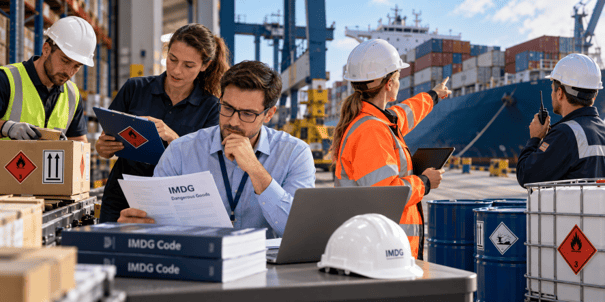
Dangerous goods transported by sea pass through many hands before they ever reach a vessel. A chemical may be classified by one employee, packed by another, documented by a logistics department, loaded into a container at a warehouse and subsequently accepted by a freight forwarder, terminal and shipping line. Every decision made during this chain can influence whether the shipment ultimately complies with the International Maritime Dangerous Goods (IMDG) Code.
For that reason, IMDG training is not limited to seafarers or employees physically handling dangerous goods. Chapter 1.3 of the IMDG Code establishes training requirements for shore-based personnel involved in the transport of dangerous goods intended to be transported by sea. The fundamental principle is that personnel must be trained in dangerous goods provisions to a level that corresponds with their responsibilities.
This makes one question particularly important for employers: who actually needs IMDG training?
IMDG training applies throughout the transport chain
A common misunderstanding is that IMDG training is primarily intended for employees working at ports or shipping lines. In reality, the scope is considerably broader. A company may be located hundreds of kilometres from the nearest seaport and still have employees who require IMDG training.
The decisive factor is not where somebody works, but what that person does.
Chapter 1.3 identifies numerous activities that can bring shore-based personnel within the IMDG training framework. These include classifying dangerous goods and identifying Proper Shipping Names, packing dangerous goods, applying marks and labels, loading and unloading Cargo Transport Units (CTUs), preparing dangerous goods transport documents, offering or accepting dangerous goods for transport and handling dangerous goods during transport.
The scope extends further to personnel preparing dangerous goods loading or stowage plans, personnel involved in loading or unloading ships, personnel carrying dangerous goods in transport and people responsible for enforcement, surveying or inspection. The Code also allows competent authorities to identify other personnel involved in dangerous goods transport who require appropriate training.
Consequently, manufacturers, chemical companies, warehouses, freight forwarders, logistics service providers, container packing stations, terminals and shipping companies should all consider whether employees within their organisation perform IMDG-related functions.
Shippers and consignors
The shipper or consignor occupies a particularly important position in the dangerous goods transport chain. Information supplied at the beginning of the shipment often determines what happens throughout the remainder of the transport operation.
Employees responsible for preparing a dangerous goods shipment may need to understand classification, UN numbers, Proper Shipping Names, packing groups, marine pollutant provisions, packaging requirements, marks, labels and documentation. Depending on their responsibilities, they may also need knowledge of limited quantities, excepted quantities and segregation requirements.
A documentation employee who completes or verifies a dangerous goods transport document is therefore not merely performing an administrative task. Incorrect information concerning a UN number, packing group or Proper Shipping Name can have operational consequences when the cargo reaches the terminal or vessel.
This is why personnel involved in preparing and offering dangerous goods shipments require training appropriate to the functions they perform.
Packers, warehouse personnel and cargo handlers
Employees who physically prepare dangerous goods for sea transport form another major group covered by the IMDG training provisions. Packing dangerous goods involves much more than placing a product into a box, drum or IBC.
The person performing the task may need to understand which packaging is permitted for the substance, whether the packaging has the appropriate UN specification marking, how combination packaging must be assembled and whether quantity limits apply. Employees may also need to understand marking and labelling requirements and the rules that apply when packages are consolidated into an overpack.
The same principle applies when dangerous goods are loaded into a freight container or another CTU. Compatibility and segregation can become important, while packages must be secured appropriately for the conditions encountered during transport by sea.
Training should therefore reflect the actual work. A warehouse employee who only moves correctly prepared packages may require a different depth of knowledge from an employee responsible for selecting packaging and preparing dangerous goods for shipment.
Freight forwarders and logistics personnel
Freight forwarders sometimes assume that the shipper bears responsibility for dangerous goods compliance and that forwarding personnel therefore require only limited knowledge. That assumption can be problematic.
Freight forwarding personnel may arrange bookings, receive dangerous goods information, prepare or transfer documentation, communicate with shipping lines and terminals or check whether cargo can be accepted for a particular route. Each of these activities can involve IMDG requirements.
For example, an employee arranging a shipment may need to recognise that certain dangerous goods require specific stowage or segregation arrangements. Another employee may need to recognise incomplete or obviously incorrect dangerous goods information before passing documentation to a carrier.
The required training should therefore be determined by the actual responsibilities assigned to the employee rather than by the employee’s job title.
Loaders, terminals and ship operators
Personnel involved in loading operations require knowledge relevant to the safe movement and placement of dangerous goods. Depending on the function, this may include dangerous goods classes, marks, labels and placards, segregation, documentation, CTU requirements and procedures for dealing with damaged or leaking packages.
Ship operators and personnel involved in vessel planning may require considerably more detailed function-specific knowledge. Stowage categories, segregation requirements and the properties of particular dangerous goods can directly influence where cargo may be positioned aboard a vessel.
This demonstrates why a single generic IMDG course is not automatically appropriate for every employee. The IMDG Code follows a function-based approach: the training must correspond with the responsibilities of the individual.
General awareness and function-specific training
Chapter 1.3 distinguishes between general awareness/familiarisation training and function-specific training. General awareness provides employees with an understanding of the overall dangerous goods transport system. This includes subjects such as dangerous goods classes, marking, labelling, placarding, packing, stowage, segregation and compatibility, together with the purpose of dangerous goods transport documentation and emergency response information.
Function-specific training goes further. Employees must be trained in the provisions that apply specifically to the work they perform.
An administrative employee who occasionally encounters dangerous goods documentation does not necessarily require the same training as a packer, consignor or ship operator. Conversely, completing only a basic awareness course should not be regarded as sufficient where an employee performs technical tasks requiring detailed IMDG knowledge.
Safety training is also relevant, commensurate with the risk of exposure and the functions performed. Personnel may need to understand accident prevention, available emergency response information, the hazards presented by dangerous goods, appropriate personal protective equipment and the immediate actions required following an accidental release.
Security requirements under Chapter 1.4 must also be considered where applicable.
Training must take place before responsibility is assumed
Another important principle is timing. Personnel should not first be given responsibility for dangerous goods activities and trained several months later. Chapter 1.3 requires relevant employees to be trained before assuming their responsibilities. Where the required training has not yet been provided, functions may only be performed under the direct supervision of a trained person.
Employers also have an organisational responsibility. They must determine which employees need training, the level of training required and the training methods necessary for those employees to perform their duties correctly.
Training is therefore not simply a matter of purchasing certificates. A company should first identify its dangerous goods functions and then match employees and training programmes to those functions.
Training records must also be maintained. The employer must be able to demonstrate which employees have received the required training. Competent authorities may request these records, and training should be periodically supplemented with refresher training to account for changes in regulations and working practices.
Does everyone need a full function-specific IMDG course?
Not necessarily. The appropriate level depends on the employee’s role.
Someone working in customer service who needs to recognise dangerous goods terminology and understand the basic shipping process may primarily require general awareness. Someone selecting packaging, signing dangerous goods documentation, loading containers or planning dangerous goods stowage needs more detailed knowledge relating to those functions.
For employees who require a general understanding of the IMDG Code rather than training for one specific operational function, the E-learning IMDG Awareness Training (English) available through IMDG-course.com provides an introduction to the international framework, dangerous goods classes, packing groups and general safety requirements.
For personnel with more direct responsibilities, IMDG-course.com also provides function-specific courses for consignors and freight forwarders, packers, ship loaders and ship operators, allowing employers to match training more closely to the work actually performed.
Start with the function, not the job title
Determining who must receive IMDG training becomes much easier when an organisation stops looking at job titles and starts analysing tasks. Ask who classifies the product, who selects the packaging, who applies the labels, who prepares or checks the transport document, who loads the container, who accepts the shipment and who decides how the dangerous goods will be handled or stowed.
Those questions reveal the real dangerous goods chain within an organisation.
The IMDG Code is built around the principle that people whose work can influence the safe transport of dangerous goods must possess knowledge appropriate to that work. In practice, this means IMDG training can be relevant from the production site and warehouse all the way through the freight forwarder, container terminal and shipping operation.
The safest approach for an employer is therefore to map every dangerous goods function, identify the employees performing those functions and select training that reflects their actual responsibilities. IMDG compliance does not begin when the container reaches the vessel. It begins with the first person who makes a decision about the dangerous goods shipment.
