Audit-Ready IMDG Training Checklist (2025): What Maritime Safety Teams Must Prepare

Why Training Records Fail Audits and How to Fix It

When an inspection happens, there’s no time to gather missing paperwork or guess who’s trained. Under IMDG Code Amendment 42-24, companies must prove not only that training happened, but that it was function-specific, up to date, and properly recorded.

Unfortunately, many teams fall short — either because records are incomplete or stored in outdated formats. This checklist helps you proactively prepare.

✅ IMDG Training Audit Checklist: 2025 Requirements

Use this list to review your documentation and procedures:

Checklist Item Why It Matters
Training Records Are Dated & Signed Proof must trace to individuals with completion dates.
Roles Are Mapped to Training Requirements Ensure each role (e.g. shipper, loader, DGSA) meets Chapter 1.3 standards.
Refresher Training Scheduled (Every 2 Years) Refresher cycles are required under IMDG guidelines.
Digital Records Stored Securely Paper-only files risk being lost or inaccessible during audits.
All Trainers Are Certified Certification ensures training validity and quality.
Emergency Response Covered Required as part of DG function-specific training.
Certificate Numbers Are Indexed Make it easy to retrieve or verify during inspection.
Training Is Function-Specific Awareness training alone isn’t sufficient for technical roles.

Download the Printable Version

We’ve created a print-ready, shareable checklist to help safety officers and compliance teams keep their records in top shape.

Training Checklist 📥 Download the Audit-Ready IMDG Checklist (PDF)

What Audit Ready IMDG Training Records Actually Look Like

This post outlines what properly documented IMDG training records look like, how to manage them across global teams, and what auditors expect during compliance checks.

What the IMDG Code Requires

Under Chapter 1.3 of the IMDG Code, all shore-based personnel involved in the transport of dangerous goods must be trained according to their role and responsibilities. In addition to the training itself, organisations must maintain records that:

  • Confirm function-specific training has been completed
  • Include the date, type, duration and method of training
  • Identify the trainee, trainer, and certification validity period
  • Are accessible during audits and inspections

What Inspectors Look For

Experienced auditors assess not just the presence but the quality and organisation of training records. During an audit, they will typically ask:

  • Are all required roles trained according to function?
  • Are refresher cycles tracked and current?
  • Can you produce certificates or proof of completion immediately?
  • Do records align with internal SOPs and booking workflows?

Common Gaps That Trigger Non-Compliance

  1. Missing Refresher Logs: Teams fail to track expiry dates or re-certification deadlines
  2. Incomplete Role Mapping: Not all DG-related positions are documented or trained
  3. Decentralised Record keeping: Sites or branches store records inconsistently
  4. No Digital Backup: Paper-only systems are lost, outdated, or inaccessible remotely

Best Practices for IMDG Recordkeeping in 2025

To meet audit standards and reduce compliance risk, top-performing organisations follow these practices:

  • Centralised digital tracking of all IMDG certifications using LMS or cloud systems
  • Automated reminders for training expiry and refresher needs
  • Role-based matrices to map required training per job title and site
  • Audit-ready folders with standard naming conventions, date stamps, and trainer details

Sample Training Record Structure

Field Example
Employee Name John Smith
Role / Function Booking Agent – Shore Based
Training Type IMDG E-learning Course – Amendment 42-24
Completion Date 15 June 2024
Expiry / Refresh Date 15 June 2026
Trainer or Provider SafetyNet International
Certificate File Name Smith_IMDG_Cert_2024.pdf

Lead Magnet: IMDG Audit-Ready Checklist

Download our free Audit-Ready IMDG Training Checklist. It includes:

  • Required training elements by role
  • Refresher interval guidelines
  • Recordkeeping do’s and don’ts
  • Certificate naming and formatting guide

Download the Checklist

Final Thoughts

IMDG Training Records are not simply compliance artefacts — they are proof of your organisation’s safety culture and operational rigour. By aligning your record keeping practices with the expectations of auditors and the requirements of the 2025 IMDG Code, you reduce the risk of non-compliance, shipment refusal, or legal exposure.

IMDG Refresher Training: How Often You Need It in 2025

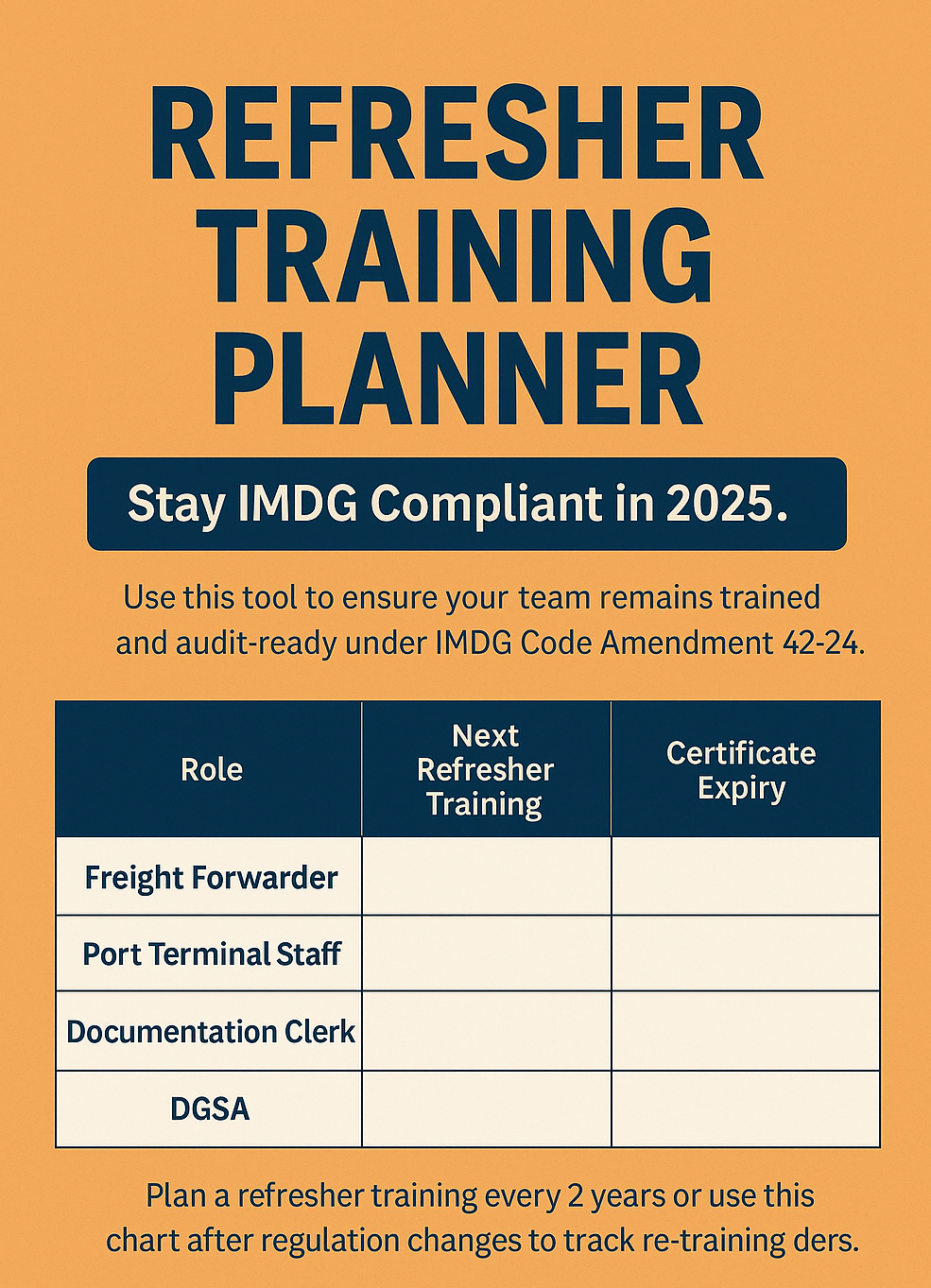
IMDG refresher training roles and calendar overview for 2025

IMDG refresher training is not optional—it is a core requirement for compliance in maritime logistics.
As Amendment 42-24 takes effect in 2025, your team must stay current with updated training expectations.
This guide outlines when refresher training is required, who needs it, and how to track it effectively to remain compliant.


What the IMDG Code Says About Refresher Training

According to Chapter 1.3 of the IMDG Code, all shore-based personnel involved in transporting dangerous goods must receive function-specific training.
Although the Code does not specify an expiry period, competent authorities typically recommend IMDG refresher training every two years or when the Code changes.
Since Amendment 42-24 introduces major updates, 2025 is the ideal time to verify your team’s training status.


Why IMDG Refresher Training Matters More in 2025

In 2025, changes to classification rules, lithium battery handling, and digital documentation come into effect.
If your team completed training under Amendment 40-20, they may now be out of date.
When refresher training is missed, you risk regulatory breaches, delayed cargo, or endangering safety.
As a result, refresher training is no longer optional, it is mission critical.


Who Needs IMDG Refresher Training?

Contrary to common assumptions, refresher training isn’t just for handlers.
It is required for any role that influences the transport of dangerous goods:

  • Freight forwarders and booking staff

  • Port handlers and stevedores

  • Warehouse teams managing labelling and packing

  • Documentation and compliance officers

  • Dangerous Goods Safety Advisors (DGSA)

Each of these roles contributes to compliance and as such, refresher training ensures they operate within updated regulations.


Planning and Tracking IMDG Refresher Training

To maintain compliance, organisations must implement a rolling refresher schedule.
For example, a simple tracker can record each employee’s last training date, the IMDG Code version used, and their next training due date.

In addition, digital records make audits simpler and reduce manual admin.
Rather than using paper certificates, switch to a shared tracker with built-in alerts.


Free Download: Refresher Training Planner

We’ve created a free IMDG refresher training planner to help HR and compliance teams stay audit-ready.
It includes:

  • A 2-year planner with certificate expiry tracking

  • Pre-filled roles and suggested retraining cycles

  • A format that works for both print and digital use

📥 Download the free planner and start building your 2025 schedule today.

You might also like:
Why IMDG Training Is Critical in 2025
Who Needs IMDG Training? Roles and Responsibilities Explained


Final Thoughts

Refresher training is more than a regulatory requirement.
It supports safety, reduces liability, and shows your team that compliance matters.
By staying ahead of the 2025 IMDG changes, you reduce risk and build a stronger compliance culture.

Who Needs IMDG Training? Roles & Responsibilities Explained

Introduction

Not everyone in the supply chain needs IMDG training — but many more roles require it t

han most realise.W

ith Amendment 42-24 coming into effect in 2025, it’s critical to understand who is legally required to complete training and what those responsibilities entail.


🔍 What the IMDG Code Says About Training

According to Chapter 1.3 of the IMDG Code, all shore-based personnel inv

olved in the transport of dangerous goods by sea must receive function-specific training.

This includes:

  • Personnel who classify, pack, mark, label or document dangerous goods

  • Those responsible for loading, unload

  • ing, or overseeing such activities

  • Employees who review, sign off, or plan DG shipments


📊 IMDG Training Responsibility Matrix

Role Training Required? Key Responsibility
Freight Forwarders & Booking Agents ✅ Yes Coordinate DG bookings, check classification, arrange transport
Shipping Line Documentation Teams ✅ Yes Review DG declarations, stowage planning
Warehouse / Packing Personnel ✅ Yes Handle packaging, marking, and labeling of DG
Port Terminal / Stevedoring Crews ✅ Yes Load/unload DG containers, apply segregation
Dangerous Goods Safety Advisors (DGSA) ✅ Yes Oversee compliance, maintain records, train others
Compliance / Documentation Officers ✅ Yes Prepare DGD forms, check MSDS, manage recordkeeping
Supervisors / Safety Officers ⚠️ Conditional Must ensure team compliance and enforce procedures
Administrative Support Staff 🟡 Depends Only if directly influencing DG documentation or routing

📄 Download the full matrix + FAQ as a cheat sheetDownload PDF


❓ Expert-Level FAQ

Q: Is IMDG training required for office staff who only handle invoices?
A: Only if they influence or review dangerous goods information on those documents.

Q: What qualifies as “function-specific” training?
A: Training tailored to the employee’s actual job duties under the IMDG Code — not just general awareness.

Q: How often should refresher training be done?
A: While not strictly regulated, best practice is every 2 years, or immediately following code updates.

Q: Is online training valid for compliance audits?
A: Yes, as long as it’s certified, documented, and includes assessment. SafetyNet’s IMDG e-learning meets these standards.


🔁 Why Training Matters

If required roles are not trained, your company may face:

  • 🚫 Rejected shipments

  • 💸 Fines or revoked approvals

  • ⚠️ Increased risk to worker and environmental safety


🎓 How to Ensure Your Team Is Trained in 2025

To stay compliant:

  • ✅ Enroll staff in certified IMDG e-learning programs

  • 🔁 Schedule refresher training at 2-year intervals

  • 💾 Maintain digital records for audit readiness

👉 Explore Our IMDG Training Course →


✅ Final Thoughts

Training isn’t just a regulation — it’s a core pillar of safety.
Now more than ever, logistics professionals, safety officers, and compliance teams must know who needs IMDG training and how to deliver it.


📁 Bonus for HR & Trainers

📄 Get the printable training matrix + FAQ
Perfect for team briefings or onboarding new hires.
Download the 1-Page Cheat Sheet →

Read more

IMDG Code 2025 Preview: What’s Changing in Amendment 42-24

What’s Changing in Amendment 42-24

The International Maritime Dangerous Goods (IMDG) Code is the cornerstone of global safety in transporting hazardous materials by sea. Updated every two years by the International Maritime Organisation (IMO), the latest revision — Amendment 42-24 — is poised to bring key regulatory changes. This update becomes optional on January 1, 2025, and mandatory on January 1, 2026.

Whether you’re a shipper, freight forwarder, compliance officer, or logistics manager, understanding these changes early can help you avoid costly delays, regulatory penalties, and training gaps.

When Does Amendment 4 2-24 Take Effect?

The IMO adopts IMDG amendments every two years. Amendment 42-24 will be:
• Optional from January 1, 2025
• Mandatory from January 1, 2026

This gives organisations one year to transition and update their compliance programs.


Key Changes in IMDG Amendment 42-24

🔹 Dangerous Goods List (DGL) Updates

  • New UN numbers added for specific materials
  • Certain substances reclassified under new hazard categories
  • Packing instructions revised for select classes and combinations

🔹 Lithium Battery Transport

• Revised marking and labelling requirements
• Tighter rules for packaging and documentation
• Alignment with UN Model Regulations

🔹 Packaging and Labelling Rules

• Enhanced clarity on pictograms and label placement
• Updates to limited quantity handling procedures

🔹 Definitions and Editorial Revisions

• Expanded explanations for marine pollutants

• Technical clarifications on classification notes

Who Is Affected by These Changes?

These updates impact a wide range of stakeholders in the DG shipping chain, including:
• Shippers and consignors
• Freight forwarders and consolidators
• Packing and warehouse personnel
• DG safety advisors and compliance staff
• Maritime operators and vessel planners

How to Stay Compliant

To ensure you’re ready for Amendment 42-24:
• Update your training programs early in 2025
• Distribute awareness materials to all affected teams
• Review and revise your internal documentation and SOPs
• Monitor IMO bulletins and check for national adoption notices
• Work with a certified DG training provider to stay ahead

Download the IMDG 2025 Cheat Sheet

Want a one-page summary of all the key changes? Download our free IMDG 2025 Cheat Sheet. It includes the most critical updates in Amendment 42-24, explained clearly for shippers, forwarders, and compliance teams.

[Download the Cheat Sheet → Link to Landing Page]

Final Thoughts

Regulatory updates are a constant in the world of dangerous goods transport. Being proactive, well-informed, and properly trained isn’t just good practice — it’s mandatory. Start preparing now so you’re not scrambling in 2026.

Need help? Visit IMDG-course.com to explore accredited online training options or book a consultation with our compliance experts.


Why IMDG Training in 2025 Is Critical for Maritime Compliance

Hazardous materials warning sign on shipping container at port terminal with crane and cargo ship in background. Text overlay reads: ‘Why IMDG Training Is Crucial in 2025 – Ensure Safe Sea Transport.

📘 Introduction

IMDG training in 2025 isn’t optional — it’s a legal requirement that’s more relevant than ever. With new dangerous goods regulations entering force under Amendment 42-24, global maritime teams must ensure their staff are properly trained and certified.
Failing to do so means exposure to delays, penalties, and safety risks. Here’s why training matters — and how to stay ahead with our IMDG e-learning courses.


📘 What Is the IMDG Code and Why It Requires Training

The International Maritime Dangerous Goods (IMDG) Code, created by the International Maritime Organization (IMO), sets the global standard for transpor

ting hazardous goods by sea.
The code is mandatory under SOLAS and MARPOL agreements. Without certified IMDG training, your teams could violate international law and endanger cargo, vessels, and crew.

👉 Learn more about the IMDG Code (IMO official site)

📘 New Training Requirements in 2025 (Amendment 42-24)

To remain compliant in 2025, training programs must address:

  • Lithium battery classification updates 
  • Mandatory refresher training cycles 
  • New packaging & labeling rules 
  • Digital documentation expectations 
  • Expanded responsibility for shore-based staff 

These changes will be optional in 2025 and mandatory by 2026.

📘 Who Needs IMDG Training in 2025?

Everyone involved in preparing, packing, handling, or shipping dangerous goods must be trained. This includes:

  • Freight forwarders 
  • Port and terminal operators 
  • Logistics managers 
  • Dangerous goods safety advisors (DGSAs) 
  • Warehouse and packaging teams 
  • Shipping agents and booking staff

📘 Why IMDG Training in 2025 Is a Smart Investment

Having your team trained reduces:

  • Risk of non-compliance fines 
  • Delays due to rejected cargo 
  • Human error in documentation or labeling 
  • Reputational damage from unsafe practices 

It also prepares your business to scale safely across global trade lanes.

🎓 Our IMDG E-Learning Course: Updated for 2025

Our accredited IMDG e-learning course is:

  • Self-paced and mobile-friendly 
  • Aligned with Amendment 42-24 
  • Designed for all key maritime roles 
  • Includes certificate upon completion


✅ Final Thoughts

With IMDG training in 2025 more critical than ever, now is the time to act. Don’t wait for enforcement deadlines — be the company that’s always ahead of the curve.


👉 Explore our IMDG e-learning course